Browse Questions By Category
Every question below comes from what buyers, cooks and importers actually ask us. Jump to the section that matches what you're looking for, or scroll through the full list.
Where it's grown, the GI tag, and how to verify it's genuine.
17 Questions 🧪Curcumin ranges, HPLC testing, and what affects potency.
34 Questions 🌿Farming methods, processing, uses and shelf life.
12 Questions 💰Why it costs more, and what drives the price.
7 Questions 📦Suppliers, minimums, private label and custom packaging.
17 Questions 🌍Licenses, destination-market certification and shipping.
8 Questions 🏭Which variety fits food, spice and nutraceutical use.
5 QuestionsOrigin & Authenticity
17 QuestionsLakadong Turmeric's reputation rests on where it's grown and how easy that origin is to verify. Here's what buyers most often ask about its background and authenticity.
- 📍Grown only in the Jaintia Hills — East or West Jaintia Hills, Meghalaya, the GI-protected origin for the name "Lakadong Turmeric."
- 🧪Lab-verified curcumin — 7–12% confirmed by HPLC testing, not just stated on a label.
- 🎨Deep golden-orange color and a strong, earthy aroma noticeably more intense than ordinary turmeric.
- 🔗Traceable origin — tied to a named cooperative or growing region, not a blended, unnamed source.
- 📄Batch-specific Certificate of Analysis available on request, matched to the exact lot being sold.
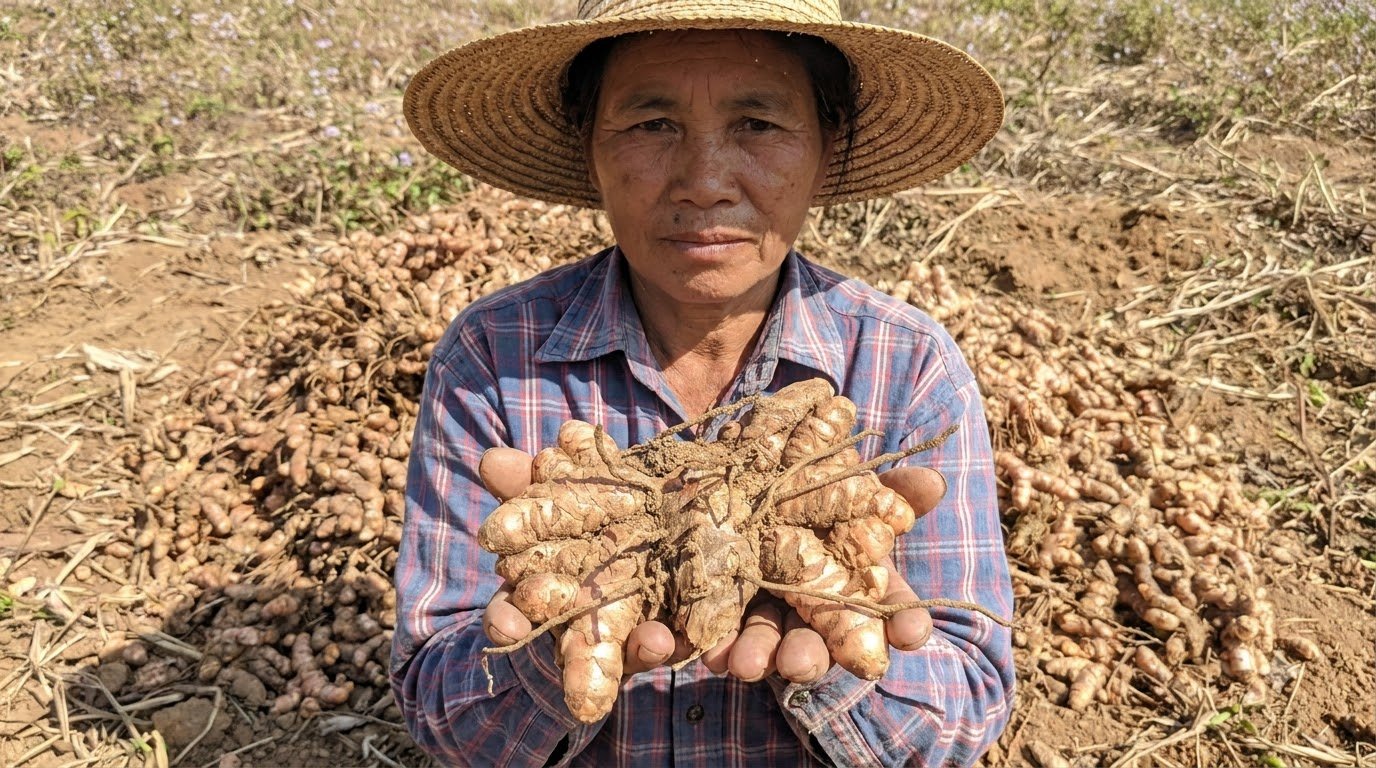
Lakadong Turmeric is traced back to a named growing region in the Jaintia Hills, not a blended, unnamed source.
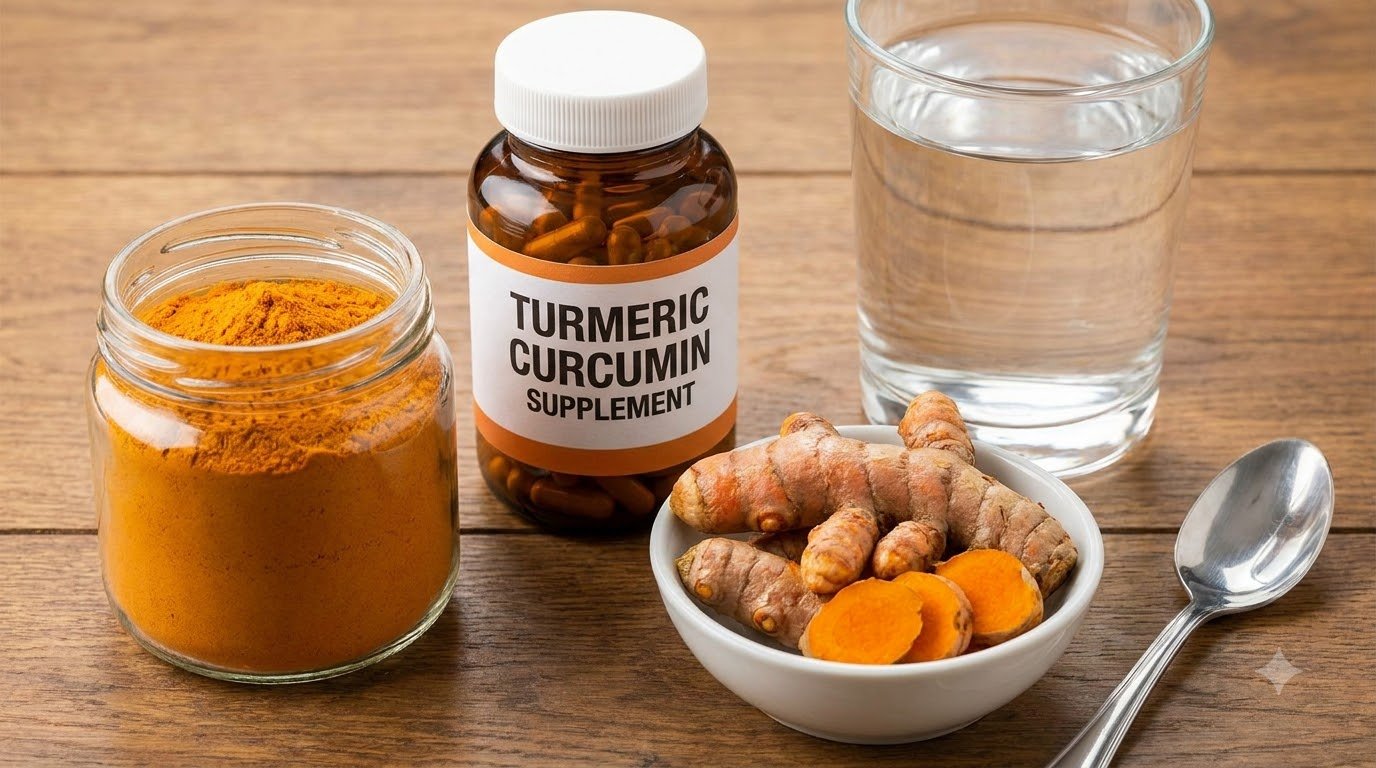
Fresh rhizomes, hand-harvested before cleaning, sun-drying and grinding.
Lakadong Turmeric is a GI-tagged turmeric variety native to the Jaintia Hills of Meghalaya, India, named after Lakadong village in West Jaintia Hills. It is prized for its unusually high natural curcumin content, typically 7% to 12%, compared with 2% to 3% in most commercial turmeric.
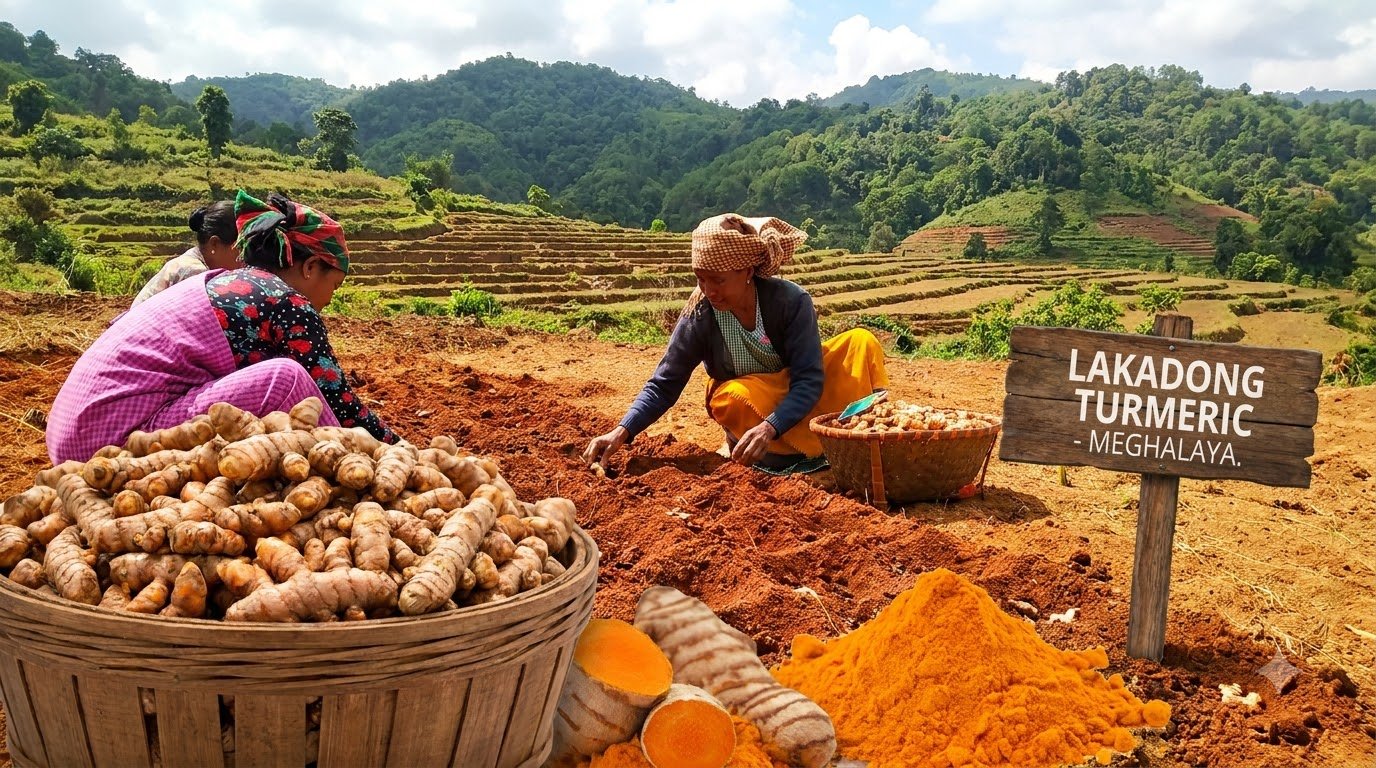
It comes from the Jaintia Hills region of Meghalaya in Northeast India, specifically the East and West Jaintia Hills districts around Jowai. Turmeric Gold sources directly from tribal Pnar/Jaintia farming cooperatives in this region.
Lakadong Turmeric is grown in the East and West Jaintia Hills districts of Meghalaya, a hill state in Northeast India. The region's black acidic soil, high altitude and monsoon rainfall are considered central to the variety's characteristic curcumin profile.
It's known internationally for having one of the highest naturally occurring curcumin contents of any turmeric variety, commonly cited between 7% and 12%. Its curcumin potential has also drawn research interest, including from scientists at Harvard University studying cell repair and disease-related properties in turmeric extracts, and it holds a Geographical Indication (GI) tag protecting the name.
The main difference is curcumin concentration, with Lakadong typically running 7-12% versus 2-3% in ordinary commercial turmeric. It also has a distinct deep golden-orange color, a stronger aroma, and is grown under traditional, largely chemical-free farming methods specific to the Jaintia Hills.
By curcumin content, Lakadong is widely regarded as the highest-curcumin turmeric variety grown in India, which is why it commands premium pricing and is sought after by nutraceutical and pharmaceutical buyers. What counts as "best" can depend on the use case though, since other varieties like Alleppey or Erode turmeric are prized for different qualities such as color intensity or culinary flavor.
Yes. Lakadong Turmeric received Geographical Indication protection from the Geographical Indications Registry, with the tag formally awarded in March 2024 following an application process that began in 2019/2021. The GI tag legally restricts the name Lakadong Turmeric to turmeric grown in the East and West Jaintia Hills of Meghalaya.
The GI (Geographical Indication) tag is a government certification confirming that Lakadong Turmeric originates from, and is uniquely associated with, the Jaintia Hills of Meghalaya, similar to how Champagne must come from the Champagne region of France. It protects farmers and buyers from turmeric grown elsewhere being mislabeled and sold under the Lakadong name.
Authentic Lakadong Turmeric should be traceable to a named farm or cooperative in the East or West Jaintia Hills, Meghalaya, with a lab-tested curcumin figure to back it up. Turmeric Gold sources directly from Jaintia Hills farming cooperatives and can supply both retail and bulk or export orders with documentation.
Look for a deep golden-orange color, a strong earthy aroma, and, most importantly, a lab report confirming curcumin content in the 7-12% range. A genuine supplier should also be able to trace the lot back to the Jaintia Hills and reference the GI registration.
Ask the supplier for a batch-specific Certificate of Analysis with an HPLC curcumin test result, and confirm the stated growing region is East or West Jaintia Hills, Meghalaya. Since the name is now GI-protected, a supplier unable to demonstrate origin or lab backing is a red flag.
Regular commercial turmeric typically contains 2-3% curcumin, while Lakadong Turmeric typically contains 7-12%. That difference in potency is also reflected in color, since Lakadong is a deeper orange-gold, aroma, and price, since curcumin content drives much of turmeric's functional and market value.
They're different profiles rather than a simple better-or-worse comparison. Alleppey Finger Turmeric from Kerala typically runs about 5% and up to 6.5% curcumin and is valued for its dark color and fresh, earthy flavor, while Lakadong Turmeric typically runs higher, at 7-12% curcumin, making it the choice where potency matters most, such as in nutraceutical extraction.
India grows more than 30 turmeric varieties, each with a different curcumin range and regional identity. Erode and Nizamabad turmeric typically run around 2.5-3.5%, and Alleppey turmeric around 5-6.5%. Lakadong Turmeric from Meghalaya's Jaintia Hills tops that range at 7-12%, which is why it's positioned as India's high-curcumin benchmark variety.
It has a robust, earthy, slightly peppery flavor with more bitterness and depth than ordinary turmeric, a natural result of its higher curcumin and essential oil content. Because it's more concentrated, less is typically needed to achieve the same flavor and color in cooking.
Lakadong Turmeric has a strong, warm, earthy aroma with woody and slightly peppery notes, more pronounced than standard turmeric due to its higher curcuminoid and essential oil content. This aroma is one of the easiest ways to tell it apart from blended commodity turmeric.
Authentic Lakadong Turmeric powder has a deep, vivid golden-orange to reddish-orange hue, noticeably darker and richer than the paler yellow of ordinary turmeric. This intense color comes directly from its higher curcumin concentration, though it's still worth confirming with lab testing rather than color alone.
See A Real Lakadong Turmeric Certificate of Analysis
Every claim on this page — 7–12% curcumin, GI-protected origin, lab-tested quality — can be backed by a batch-specific Certificate of Analysis. Request a sample COA before you order.
Curcumin Content & Lab Testing
34 QuestionsCurcumin content is the single most-asked-about spec on Lakadong Turmeric. These questions cover its typical range, how it's tested, how it compares to other varieties, and what affects it.
Lakadong Turmeric typically contains 7% to 12% curcumin on a dry-weight basis, verified through lab testing such as HPLC. Some lots have recorded curcumin as high as 13.8%, though actual content always varies by harvest and should be confirmed per batch.
Yes. At 7-12% curcumin, Lakadong Turmeric is considered one of the highest-curcumin turmeric varieties grown anywhere, roughly 3 to 6 times more concentrated than the 2-3% typical of ordinary commercial turmeric.
The upper end of Lakadong Turmeric's typical range is around 12%, with select high-performing lots recorded as high as 13.8% curcumin. Actual peak values depend on the specific harvest and testing method, so a lot-specific Certificate of Analysis is the only way to confirm an individual batch.
Most Lakadong Turmeric lots test between 7% and 12% curcumin by weight, compared with roughly 2-3% for typical commodity turmeric. Exact content should always be confirmed on a batch's Certificate of Analysis rather than assumed from the general range.
High-curcumin turmeric refers to turmeric varieties or lots that test meaningfully above the roughly 2-3% curcumin typical of ordinary commercial turmeric. In trade terms, anything from about 5% upward is generally considered high-curcumin, with varieties like Lakadong at 7-12% and Alleppey at 5-6.5% representing the higher end of what's commercially available.
Among commercially traded Indian turmeric varieties, Lakadong Turmeric from Meghalaya's Jaintia Hills is generally cited as having the highest natural curcumin content, typically 7-12%, notably higher than other recognized high-curcumin varieties such as Alleppey Finger Turmeric at 5-6.5%.
Lakadong Turmeric, grown in Meghalaya's Jaintia Hills, is widely recognized as India's highest-curcumin turmeric variety, with a typical range of 7-12% compared to roughly 2-3% for standard commodity turmeric grown elsewhere in the country.
Yes. At 7-12% curcumin, Lakadong sits well above other recognized high-curcumin varieties like Alleppey at 5-6.5%, and considerably above regional commodity varieties like Erode or Nizamabad turmeric, which typically run 2.5-3.5%.
Its high curcumin content is attributed to the specific combination of black acidic soil, high altitude, and heavy monsoon rainfall found in the Jaintia Hills, along with the traditional cultivar itself and generations of selective seed-rhizome saving by local farmers.
There's no single official cutoff, but in the spice trade, curcumin content above roughly 5% is generally considered high, since ordinary commodity turmeric usually tests at 2-3%. Varieties like Lakadong at 7-12% sit well above that threshold and are marketed specifically on that basis.
Yes, 5% is generally considered high-curcumin in trade terms, since it's roughly double the 2-3% typical of ordinary commercial turmeric. It's around the level associated with premium varieties like Alleppey Finger Turmeric, though still lower than Lakadong Turmeric's typical 7-12% range.
Yes, 7% curcumin is considered high-curcumin turmeric and sits at the lower end of Lakadong Turmeric's typical 7-12% range. It's roughly three times the curcumin content of ordinary commercial turmeric.
Yes, 8% curcumin is well within the high-curcumin category and falls comfortably inside Lakadong Turmeric's typical 7-12% range, roughly three to four times more concentrated than standard commercial turmeric.
Yes. 10% curcumin is achievable and is regularly recorded in Lakadong Turmeric lots from the Jaintia Hills, which typically range from 7% to 12%, with peak lots recorded as high as 13.8%. It is not typical of most commercial turmeric grown elsewhere.
Curcumin content is measured in an accredited laboratory, most commonly using High-Performance Liquid Chromatography, or HPLC, which separates and quantifies the curcuminoid compounds in a sample. The result is expressed as a percentage of curcumin by dry weight and reported on a Certificate of Analysis.
A representative sample of the turmeric powder is sent to a lab, where curcuminoids are extracted and quantified using HPLC, the industry-standard method, or less precisely, spectrophotometry. The result is reported as a curcumin percentage on a Certificate of Analysis specific to that batch or lot.
HPLC, or High-Performance Liquid Chromatography, is the standard, most accurate laboratory method for measuring curcumin content in turmeric. It's the test referenced on Turmeric Gold's Certificate of Analysis for curcumin content, alongside other parameters like moisture and ash.
HPLC stands for High-Performance Liquid Chromatography, a laboratory technique that separates and precisely quantifies each curcuminoid compound, namely curcumin, demethoxycurcumin and bisdemethoxycurcumin, in a turmeric sample. It's considered the gold-standard method for reporting curcumin percentage on a Certificate of Analysis.
Request a batch-specific Certificate of Analysis showing an HPLC curcumin test result for the exact lot you're buying, not a general company average. For added assurance on larger orders, buyers can also submit an independent sample to their own accredited lab before confirming a shipment.
Yes, curcumin content naturally varies from batch to batch, even within the same variety and growing region, due to differences in harvest timing, soil conditions, rainfall and plant maturity. That's why a lot-specific Certificate of Analysis, not a general product average, is the only reliable way to confirm a particular shipment's curcumin content.
Curcumin content is influenced by growing conditions such as soil composition, rainfall, altitude and temperature during the growing season, as well as harvest timing and post-harvest handling. Even turmeric from the same field can show some variation year to year, which is why testing is done per batch rather than relying on a fixed figure.
Yes, growing location is one of the biggest factors, since soil type, altitude, rainfall and microclimate all influence how much curcumin a turmeric plant produces. This is part of why Lakadong Turmeric's specific origin in the Jaintia Hills is central to its curcumin profile and why the name is now GI-protected.
Yes. Turmeric grown in the Jaintia Hills' black acidic soil is associated with notably higher curcumin levels than turmeric grown in other soil types, one of the reasons the region's terroir is considered difficult to replicate elsewhere.
Processing can influence curcumin content to some degree, since excessive heat during drying, prolonged storage, or exposure to light and moisture can all degrade curcuminoids over time. Careful sun-drying and prompt, proper storage after harvest help preserve the curcumin levels present in the fresh rhizome.
Gentle, traditional sun-drying, as used for Lakadong Turmeric on bamboo mats, is generally considered to preserve curcumin better than fast, high-heat industrial drying, which can degrade some curcuminoids. Properly dried and stored turmeric should retain the curcumin level established at harvest.
Grinding itself doesn't significantly reduce curcumin content, but excessive heat generated during high-speed milling can degrade some curcuminoids, which is why stone-grinding or carefully controlled mechanical milling is preferred for high-curcumin turmeric. Properly ground powder should test close to the curcumin level of the dried rhizome it came from.
Yes, curcumin content gradually declines during storage, especially with exposure to light, heat, moisture and air. Turmeric powder kept in an airtight, moisture-barrier container away from direct sunlight retains its curcumin content significantly longer than powder left in open or clear packaging.
Turmeric is the whole spice, the dried, ground rhizome of the Curcuma longa plant. Curcumin is just one active compound within turmeric, a curcuminoid, responsible for its color and much of its studied bioactivity; the curcumin content of a turmeric powder is the percentage of this compound present.
Yes, curcumin occurs naturally in the turmeric rhizome as one of its curcuminoid compounds and isn't added separately. The amount present varies by variety and growing conditions, from around 2-3% in ordinary turmeric to 7-12% in high-curcumin varieties like Lakadong.
Curcuminoids are the group of related yellow-orange pigment compounds found in turmeric, of which curcumin is the main and most studied component, alongside demethoxycurcumin and bisdemethoxycurcumin. Together they're responsible for turmeric's color and much of its functional properties.
Curcuminoids is the umbrella term for the three related pigment compounds in turmeric, namely curcumin, demethoxycurcumin, and bisdemethoxycurcumin, while curcumin specifically refers to just the primary, most abundant one of the three. A curcumin content figure on a lab report typically refers to curcumin specifically, though some tests report total curcuminoids.
High-curcumin varieties test highest for total curcuminoids as well, since curcumin makes up the bulk of the curcuminoid content. Lakadong Turmeric, at 7-12% curcumin, is among the highest-testing varieties for total curcuminoid content of any commercially available turmeric.
Yes, Lakadong Turmeric is naturally high in total curcuminoids, driven by its high curcumin content, without any additives, extraction or fortification involved. The high level comes directly from the plant variety and the Jaintia Hills growing conditions.
In terms of curcumin concentration, yes. Lakadong Turmeric is typically 3 to 6 times more concentrated than ordinary commercial turmeric, which in practice means a smaller quantity delivers the same color, flavor intensity and curcumin dose as a larger amount of standard turmeric.
Organic Growing, Uses & Storage
12 QuestionsHow Lakadong Turmeric is grown, processed and used, and how to keep it fresh once it reaches you.
Lakadong Turmeric is traditionally grown without synthetic pesticides or fertilizers, using farming methods passed down through Jaintia Hills tribal communities. Formal organic certification such as NPOP, USDA NOP, EU Organic or JAS can be arranged for a specific lot on request; ask for the certificate scoped to your exact shipment rather than assuming a general organic claim applies.
Yes. Lakadong Turmeric is traditionally cultivated using rain-fed methods with no irrigation systems, hand-weeding instead of herbicides, and compost rather than synthetic fertilizer, practices that have been used in the Jaintia Hills for generations.
Yes, certified organic Lakadong Turmeric can be supplied for bulk and export orders, with organic documentation such as NPOP, USDA NOP, EU Organic or JAS facilitated on request depending on the destination market. Always confirm the certificate is scoped to the specific lot you're purchasing, not just a general company credential.
Turmeric Gold can supply organic-certified Lakadong Turmeric in bulk and export formats, with certification arranged for the relevant destination market on request. Contact our export team with your required certification standard and order volume to get started.
Because of its high curcumin content, Lakadong Turmeric is associated with the antioxidant, anti-inflammatory and digestive properties traditionally linked to turmeric, along with a stronger natural color and flavor in cooking. These are traditional and researched properties of curcumin generally; specific health decisions should be discussed with a healthcare professional.
It's used in cooking such as curries, dals, rice dishes and marinades, in wellness preparations like golden milk and turmeric tea, in natural skincare masks, and as a raw material for nutraceutical, pharmaceutical and cosmetic manufacturing where its high curcumin content is especially valued.
Rhizomes are hand-harvested, cleaned, and traditionally sun-dried on bamboo mats before being stone-ground or mechanically milled in certified facilities. The powder is then graded and lab-tested for curcumin content before packaging.
Processing follows a traditional sequence of hand harvesting, washing, sun-drying rather than industrial heat-drying to help preserve curcumin, then stone-grinding or controlled mechanical milling, followed by grading, lab testing and packaging.
Store it in an airtight container, away from direct sunlight, heat and moisture, ideally in a cool, dry pantry. This preserves both its curcumin content and its color and aroma for longer.
Properly stored in an airtight container away from light and moisture, turmeric powder generally stays good for around 2 to 3 years, though its aroma and color are typically most vibrant within the first 12-18 months. Bulk buyers should check the specific shelf life stated on their batch's documentation.
The same principles apply as with any turmeric powder, but matter more given the higher curcumin content at stake: an airtight, moisture-barrier container, kept away from heat, light and humidity, is essential to prevent curcumin degradation over time.
High-curcumin turmeric powder, properly sealed and stored away from heat, light and moisture, typically retains good quality for 2 to 3 years, though curcumin levels gradually decline over time regardless of variety. For bulk and export orders, moisture-barrier packaging is used specifically to protect this shelf life during transit.
Pricing & Value
7 QuestionsPricing depends on curcumin grade, volume and certification rather than a single fixed number — here's how buyers should think about it.
Wholesale pricing depends on curcumin grade, order volume, packaging format, organic certification requirements and shipping terms, so there isn't one fixed number. Contact our export team with your required volume and specification for a current quote.
Per-kilogram pricing varies with curcumin content, order size, product form, packaging and destination, since high-curcumin, organic-certified, export-documented lots are priced differently than standard trial quantities. Reach out with your requirements for an accurate, current quote.
It commands a premium because of its significantly higher curcumin content compared with ordinary commodity turmeric, its GI-protected, single-origin traceability, and the more labor-intensive, small-farmer cultivation methods used in the Jaintia Hills. Limited growing area and rising international demand also play a role.
It's considered premium due to the combination of exceptionally high curcumin content at 7-12%, verified single-origin traceability tied to a GI tag, traditional chemical-free farming methods, and consistent lab-backed quality documentation, factors that matter most to nutraceutical, pharmaceutical and specialty food buyers.
For buyers where curcumin potency matters, such as nutraceutical formulation, pharmaceutical extraction, or premium food and wellness products, the higher curcumin content usually means less raw material is needed to hit the same potency target, which can offset some of the price premium. For general culinary use, the value depends on how much you prioritize flavor intensity and color over cost.
High-curcumin turmeric typically costs more per kilogram than standard commodity turmeric, with pricing scaling further with curcumin grade, certification and order volume. Contact our team for current pricing based on your specific curcumin and volume requirements.
Pricing for high-curcumin turmeric powder depends on the specific curcumin percentage required, whether organic certification is needed, order quantity, and packaging format. Get in touch with your target curcumin range and volume for an accurate quote.
Wholesale, Bulk & Sourcing
17 QuestionsFor businesses buying at volume, here's what to know about minimums, private labelling, and sourcing directly from Jaintia Hills growers.
Turmeric Gold supplies Lakadong Turmeric in bulk directly from Jaintia Hills farming cooperatives, in formats from 25kg trial bags up to 1,000kg jumbo FIBC bags or full container loads. Contact our team or register as a buyer to start a bulk order.
A reliable supplier should source directly from the Jaintia Hills, provide lot-specific lab documentation for curcumin content, and be able to reference the GI-protected origin. Turmeric Gold works directly with Jaintia Hills cooperatives and supplies lab-tested, traceable Lakadong Turmeric for wholesale and export.
Turmeric Gold sources directly from tribal Pnar/Jaintia farming cooperatives across the East and West Jaintia Hills, working with over 13,000 farmers across 124 villages, cutting out unnecessary middlemen between farm and buyer.
Supply is anchored by the Jaintia Hills farming cooperatives themselves, including bodies such as the Lakadong Turmeric Cooperative Union based in Jowai, with export-ready sourcing and documentation handled by partners like Turmeric Gold, who work directly with these grower communities.
Wholesale orders can be placed directly with Turmeric Gold, starting from around 25kg trial quantities up to full container loads, with lab documentation and packaging matched to your intended use. Use the contact form or buyer registration page to get a quote.
Direct-from-farm sourcing is typically arranged through a cooperative or export partner rather than an individual farmer, since export documentation, lab testing, and consolidated packaging need to be handled centrally. Turmeric Gold provides this direct link to Jaintia Hills farming cooperatives on behalf of wholesale and export buyers.
The typical minimum is around 25kg for a retail or trial order, and 500kg for standard wholesale orders, though this can vary by product form and packaging. Contact our team to confirm current minimums for your specific requirement.
Yes, private label supply is available. Unbranded bulk Lakadong Turmeric can be repacked, jarred, or bottled under your own brand, with custom labeling and packaging arranged to your specification.
Yes, packaging can be customized in format, such as pouches, woven or kraft bags, jute sacks, or jumbo FIBC bags, along with size and labeling, including private label branding. Discuss your packaging requirements with our export team when placing a bulk order.
You can reach Turmeric Gold via WhatsApp at +91 89002 00595, by email at contact.indianmercantile@gmail.com, or through the contact and buyer registration forms on this site. Our team typically responds within 12 hours.
Within India, high-curcumin turmeric is available directly from growing-region suppliers such as Turmeric Gold, sourcing Lakadong Turmeric at 7-12% curcumin from Meghalaya's Jaintia Hills, in both retail and bulk quantities.
High-curcumin turmeric powder, specifically Lakadong Turmeric at 7-12% curcumin, is available from Turmeric Gold in retail, wholesale and export formats, sourced directly from Jaintia Hills cooperatives with lab documentation for every batch.
Turmeric Gold supplies high-curcumin Lakadong Turmeric in bulk, from 25kg trial bags through to full container 20MT export loads, with a lot-specific Certificate of Analysis confirming curcumin content for every shipment.
Turmeric Gold exports high-curcumin Lakadong Turmeric from India, handling the full documentation chain, including IEC, FSSAI, APEDA, Spices Board registration, phytosanitary certification and Certificate of Origin, for shipment to international buyers.
In practice, high-curcumin turmeric for wholesale or export is sourced through a cooperative or export partner connected to the growing farmers, rather than negotiated individually with a single farmer, since lab testing, grading and export documentation need to be consolidated. Turmeric Gold provides this direct link to Jaintia Hills growers for buyers.
Yes, both domestic and international buyers can order high-curcumin Lakadong Turmeric directly from Turmeric Gold in India, in retail, wholesale, or export FOB/CIF quantities, with full lab and export documentation.
Start by defining your required curcumin range, order volume, product form and any certification needs such as organic, kosher or halal, then contact our export team or register as a buyer. We'll confirm specifications, share a sample and Certificate of Analysis, and guide you through the order and shipping process.
Get A Bulk Or Export Quote For Lakadong Turmeric
Tell us your required curcumin grade, volume, packaging and certification needs, and our export team will get back to you within 12 hours with a quote and sample options.
Export & International Buyers
8 QuestionsInternational buyers ask us most often about licenses, destination-market certification, and shipping terms — here's a quick reference.
Turmeric Gold exports Lakadong Turmeric from India, working with the necessary Indian export registrations such as IEC, FSSAI, APEDA and Spices Board registration to ship internationally on FOB or CIF terms.
Register as a buyer through our export page, specify your country, required volume and product form, and our export team will guide you through sampling, documentation, pricing and shipping terms, whether FOB Indian port or CIF to your destination port.
Lakadong Turmeric is exported to markets including the United States, European Union countries, United Kingdom, UAE and other Gulf states, Australia, Japan and Canada, each with its own specific import and certification requirements.
Yes. Exports to the EU typically require a Phytosanitary Certificate, compliance with EFSA food safety standards, and EU Organic certification under Regulation 2018/848 if the shipment is marketed as organic, along with standard export documentation like the Certificate of Origin.
Yes. US-bound shipments typically require FDA registration and compliance, a Phytosanitary Certificate, sometimes a fumigation certificate, and USDA NOP organic certification if the product is marketed as organic in the US.
Common requirements include an Indian Import Export Code, FSSAI license, APEDA and Spices Board registration, and a Phytosanitary Certificate and Certificate of Origin for most destinations. Depending on the market, buyers may also need organic certification such as USDA NOP, EU Organic or JAS, Halal or Kosher certification, or standards like ISO 22000; exact requirements depend on the destination country and buyer specification.
Yes, a Certificate of Analysis including HPLC-tested curcumin content, along with moisture, ash and other quality parameters, is provided for export orders and can be shared for buyer review before shipment. Sample COAs can be requested through our export team.
The best export variety depends on the buyer's use case. Lakadong Turmeric at 7-12% curcumin suits buyers prioritizing potency, such as nutraceutical and pharmaceutical manufacturers, while Alleppey Finger Turmeric at 5-6.5% curcumin is often preferred by buyers prioritizing color and traditional culinary flavor in markets like the US and Europe.
Best Turmeric By Industry
5 QuestionsDifferent buyers weigh curcumin content, flavor and cost differently. Here's how Lakadong Turmeric compares for common industry use cases.
For a high-potency, deep-colored powder, Lakadong Turmeric is a strong choice given its 7-12% curcumin content, which translates into stronger color, aroma and functional strength per gram than standard varieties.
Lakadong Turmeric is generally the top choice for high-curcumin powder, given its typical 7-12% curcumin range, meaningfully higher than other recognized high-curcumin varieties like Alleppey Finger Turmeric at 5-6.5%.
It depends on the application. Manufacturers prioritizing strong natural color and potency with less powder needed per batch often choose Lakadong Turmeric, while those matching a specific traditional flavor profile might choose a variety like Alleppey or Madras turmeric instead.
Spice manufacturers blending for color intensity and potency, rather than a specific regional flavor profile, often favor high-curcumin varieties like Lakadong Turmeric, since a smaller quantity delivers stronger color and aroma in the final blend.
High-curcumin varieties are generally preferred for nutraceutical use, since curcumin content directly affects extraction yield and potency. Lakadong Turmeric's 7-12% curcumin range makes it a commonly sourced raw material for supplement and extract manufacturers targeting high-potency curcumin products.
Didn't Find What You Were Looking For?
This page covers the questions we're asked most, but every order has its own details — curcumin target, destination country, certification, packaging. Reach out directly and our team will answer with specifics for your order.
We work directly with Jaintia Hills farming cooperatives to supply NABL lab-tested, GI-protected Lakadong Turmeric — 7-12% curcumin, organic documentation on request, and private label options for brands on every shipment. Reach out through the form below for wholesale or export enquiries.