Why Authentic Origin Should Be the First Thing a Wholesale Buyer Verifies
In the spice trade, "Lakadong" has become something close to a category name rather than a guarantee of source. Turmeric grown far from Meghalaya, blended with other regional lots, or simply relabeled at a trading hub can still reach a buyer's inbox described the same way as turmeric genuinely harvested in the Jaintia Hills. For a retail customer buying a small jar, that distinction may not matter much. For a wholesale or export buyer building a supplement line, a spice blend, or a private-label product around Lakadong turmeric's reputation for high curcumin content, it matters a great deal.
The practical risk isn't just about labeling accuracy. Curcumin content, color intensity and aroma vary meaningfully between turmeric grown in the Jaintia Hills' particular soil and climate and turmeric grown elsewhere but sold under the same name. A buyer who orders on the strength of a name alone, without asking how that specific batch was actually sourced, can end up with a product that doesn't perform the way their formulation or label claim assumes it will.
Working with a genuine Lakadong turmeric wholesale supplier means working with one that can answer a simple question directly: which growing community did this batch come from, and can it be proven? The rest of this guide covers what that proof should look like, and what a serious wholesale and export relationship with an authentic origin Lakadong turmeric supplier typically involves.
Before discussing volume or packaging, ask a prospective supplier one direct question: can this specific batch be traced back to a named growing community in the Jaintia Hills, with lab testing to support it? A supplier who answers clearly and can back it up with paperwork is worth shortlisting. A vague answer is worth noting too.
Authentic Lakadong Turmeric, By the Numbers
These aren't marketing percentages pulled from thin air — they describe the sourcing and testing standard a wholesale buyer should expect from any supplier claiming genuine Jaintia Hills origin.
Our Sourcing & Testing Standard, at a Glance
Figures reflect the internal standard applied across wholesale and export orders. Batch-specific results are always confirmed on the accompanying Certificate of Analysis.
What Actually Sets Genuine Lakadong Turmeric Apart
Turmeric grown in the Jaintia Hills of Meghalaya benefits from a specific combination of altitude, high rainfall and mineral-rich hill soil that isn't easily replicated in the plains regions where most Indian turmeric is grown. Within the spice trade, that combination is generally understood to produce rhizomes with a deeper orange-red color and a naturally higher curcumin content than typical commercial turmeric, without any additional processing.
The visible differences are the easiest to describe: a more intense red-orange tone when cut or powdered, and a sharper, more resinous aroma than milder commercial varieties carry. The differences that matter most to a formulator, though, show up on a lab report rather than to the eye — curcuminoid percentage, moisture content, and the absence of pesticide or solvent residue.
None of this is inherent to the word "Lakadong" printed on a bag. It's a function of where the rhizome actually grew, how it was harvested and dried, and how carefully it was kept separate from other lots on the way to a buyer. That's the case for treating origin as something to verify, not something to take on trust.
Authentic Origin Lakadong Turmeric vs. Generic Blended Turmeric
This is a general comparison of what buyers typically encounter in the market, not a claim about any specific competitor's product. Use it as a starting checklist when a quote looks unusually generic or a specification sheet doesn't reference an actual batch.
What the Label Says vs. What the Batch Actually Is
Six points worth checking before assuming any turmeric labeled "Lakadong" meets the same standard.
| Attribute | Authentic Origin Lakadong | Generic / Blended Turmeric |
|---|---|---|
| Origin Traceability | Traced to a named Jaintia Hills growing community | Often unspecified or region-blended |
| Curcuminoid Range | Naturally higher, confirmed by batch COA | Varies widely, rarely batch-specific |
| Color & Aroma | Deep orange-red, resinous aroma | Lighter tone, milder or inconsistent aroma |
| Sourcing Practice | Direct farmer partnerships | Frequently aggregated through open-market trading |
| Batch Documentation | COA, curcumin & residue-free reports per batch | Generic spec sheet, not tied to the shipment |
| Order-to-Order Consistency | Same growing region, repeatable specification | Can shift depending on which lot was available |
Inside the Jaintia Hills Growing Region
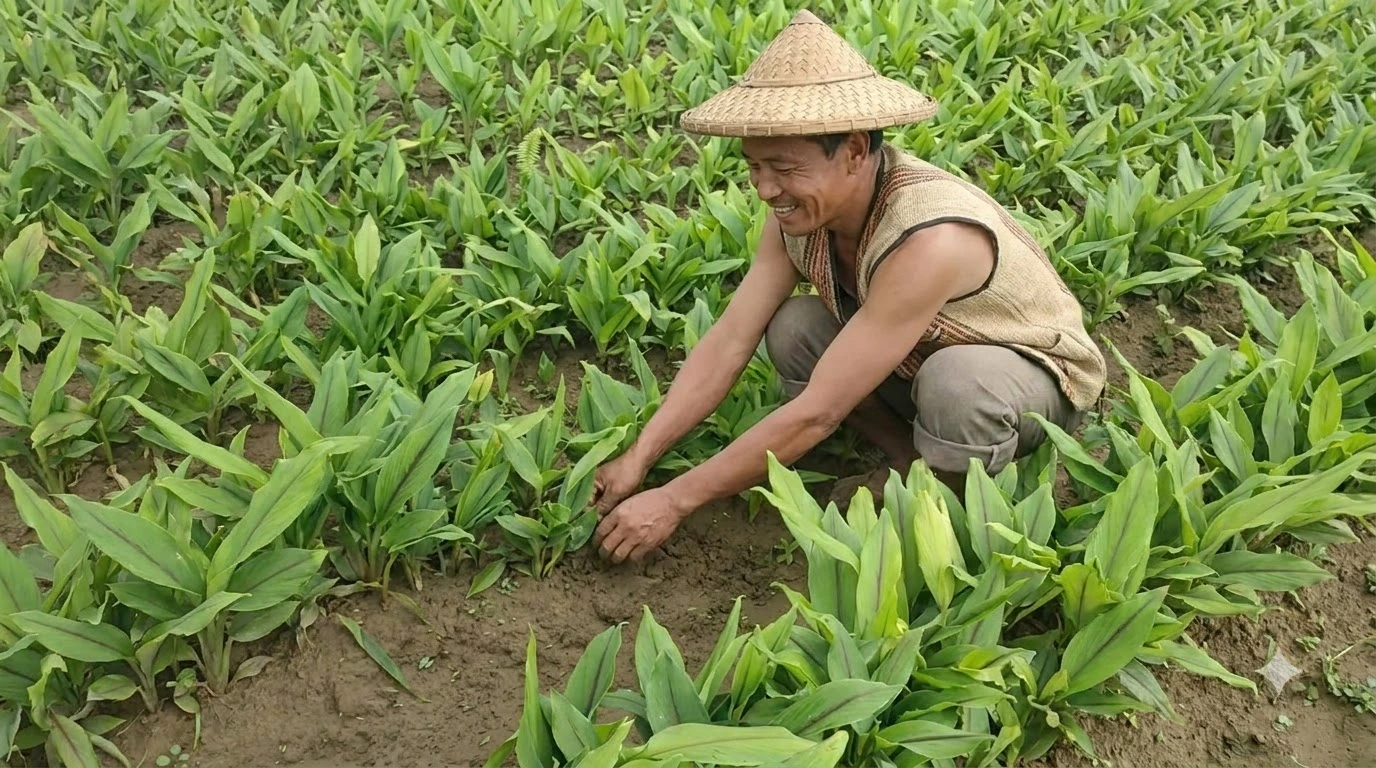
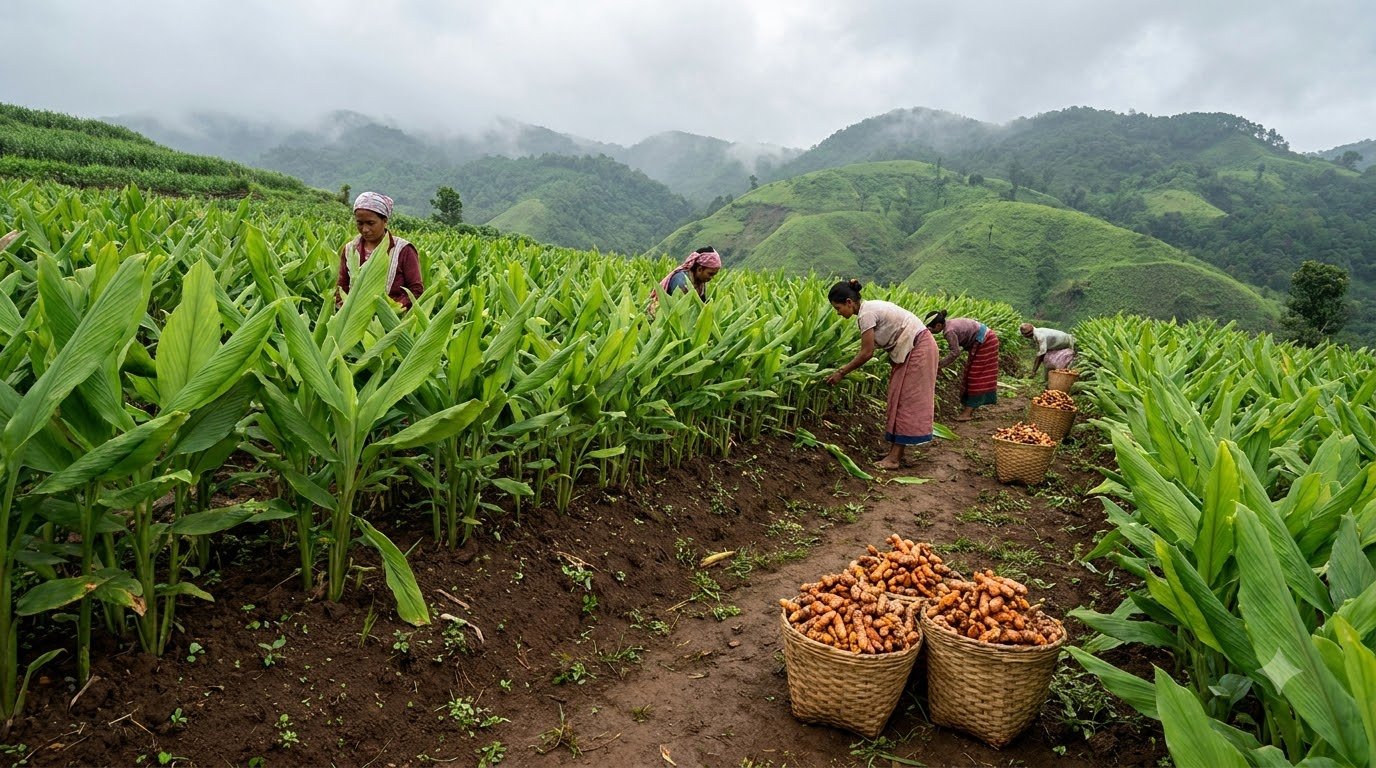
The Jaintia Hills sit in Meghalaya, one of the wettest regions in the world, where turmeric has been grown by hill farming communities for generations, largely for local and regional use before demand from wholesale and export buyers grew. Farming here still happens mostly at a smallholder scale, spread across hill terrain rather than large flat plantations.
Working directly with these farming communities — rather than buying turmeric that has already changed hands two or three times through regional traders — is what makes batch-level traceability possible in the first place. It also means harvest timing, drying method and initial grading can be documented from the point of harvest, not reconstructed after the fact.
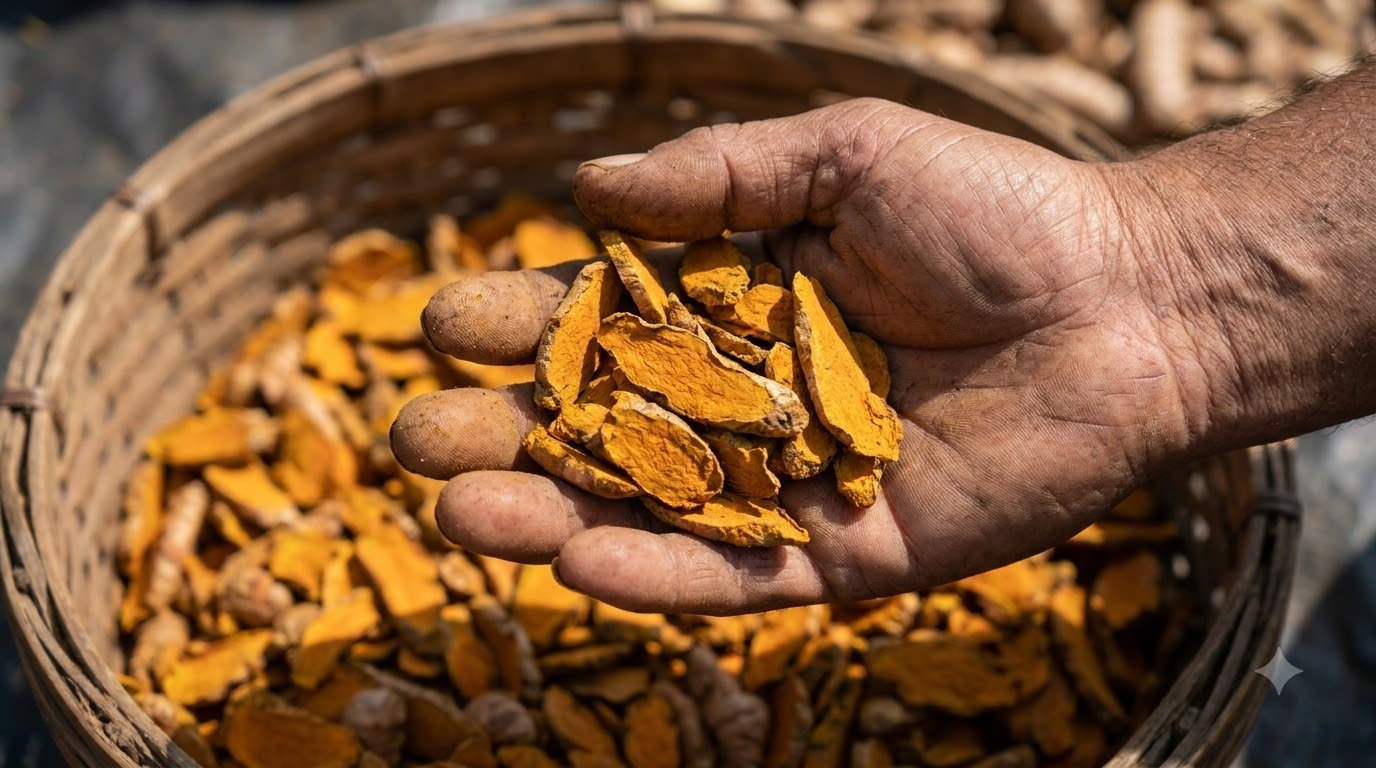
Rhizomes are graded soon after harvest, before they're dried and prepared for wholesale and export orders.
Color and aroma are among the first things buyers notice — and among the easiest ways to spot an inconsistent lot.
From Jaintia Hills to Your Wholesale Order
Here's the sequence a properly traced Lakadong turmeric order should follow, and where documentation should exist at every stage along the way.
The Journey of a Traceable Lakadong Turmeric Batch
Six checkpoints between harvest and a wholesale shipment reaching your facility.
Want to See a Real Certificate of Analysis Before You Commit?
For wholesale and export buyers evaluating an authentic origin Lakadong turmeric supplier, reviewing a batch-specific COA, curcumin certification and residue-free report is the most direct way to confirm a claim before placing an order. Product specifications and documentation are shared according to the particular order.
Wholesale Formats & Packaging for Bulk Buyers
Wholesale and export buyers rarely want the same format. A spice trading company usually wants whole dried rhizomes or fingers in bulk. A supplement manufacturer usually wants standardized powder or extract. A private label brand often wants both the product and the packaging built around its own specification.
A genuine Lakadong turmeric wholesale supplier working at scale should be able to offer whole dried turmeric, ground powder, and standardized curcuminoid extract, each traceable back to the same Jaintia Hills sourcing. Bulk packaging is typically supplied in moisture-controlled, poly-lined bags or drums, with batch coding carried through from the lab report to the shipment itself.
- 🌾Whole Dried Turmeric — Fingers and bulbs, sun-dried and graded, sourced directly from Jaintia Hills growing communities.
- 🥄Turmeric Powder — Ground from the same traceable rhizomes, tested for curcuminoid content and residue on every batch.
- 🧪Standardized Curcuminoid Extract — Available for buyers who need a specific concentrated curcuminoid percentage rather than whole-spice format.
- 🏷️Private Label & OEM Packaging — Custom packaging formats available; minimum quantities and lead times confirmed per order.
Who Buys Lakadong Turmeric on a Wholesale Basis
The reasons a buyer wants authentic origin Lakadong turmeric specifically, rather than generic commercial turmeric, tend to fall into a handful of recurring categories.
Buy whole rhizomes or powder in bulk for repacking, blending, or use as an ingredient in packaged food products.
Source turmeric valued for its naturally higher curcumin content as a base for capsules, tablets and functional powders.
Look specifically for traceable, single-origin turmeric to support formulations built around ingredient provenance.
Order wholesale volumes packaged under their own branding for retail or e-commerce distribution.
How to Verify a Supplier's Authentic Origin Claim
Origin claims are easy to make and, from a distance, hard to disprove without documentation. These are the practical signs that separate a supplier who can back up an authentic Lakadong turmeric claim from one who's simply using a well-known name.
- Can name the specific growing community or area the batch came from
- Provides a batch-specific COA matching the shipment's own lot number
- Offers a curcumin certification confirming potency for that batch
- Can produce a residue-free testing report on request
- Specification stays consistent between a sample and the bulk order
- Willing to discuss sourcing practices in detail, not just marketing language
- Origin described only in general terms, with no specific growing area named
- No documentation offered alongside an evaluation sample
- Testing described only as "in-house," with no independent lab report
- Reluctance to explain how batches are sourced or kept separate
- Curcumin content or color that shifts noticeably between sample and bulk order
- Pressure to commit to volume before any documentation is reviewed
Documentation We Provide With Every Wholesale Batch
Three documents, specifically, are what we consider non-negotiable for any wholesale or export order — and what any serious buyer should ask for, regardless of which supplier they're evaluating.
- 🔬Certificate of Analysis (COA) — Batch-specific figures for curcuminoid content, moisture and other quality parameters, matched to the actual shipment's lot number.
- 🌿Curcumin Certification — Confirms the potency and purity of the curcuminoids present in that specific batch.
- 🧼Residue-Free Certification — Lab-confirmed testing showing the batch is free of pesticide and solvent residue above acceptable limits.
- 📋Matching Batch Coding — The lot number on the paperwork matches the code on the bags or drums that actually arrive.
- 🔁Repeat-Order Consistency — A second, independently reviewed batch is a fair way to confirm a supplier holds the same standard on future orders, not just the first one.
How to Place a Wholesale or Export Enquiry
The process for a first-time wholesale enquiry is usually straightforward, and most of the work is simply asking for the right things in the right order.
Request a Sample & Batch Documentation Pack
Want to see what a properly traced Lakadong turmeric batch actually looks like on paper before committing to a wholesale order? We can share a specification sheet alongside COA, curcumin certification and residue-free testing details for your review.
FAQs — Authentic Origin Lakadong Turmeric Supplier
Turmeric grown in Meghalaya's Jaintia Hills benefits from high rainfall and hill soil conditions that tend to produce a deeper color and naturally higher curcumin content than typical commercial turmeric grown elsewhere. The difference is most reliably confirmed through batch-specific lab testing rather than by name alone.
Ask the supplier to name the specific growing community the batch came from, request a batch-specific Certificate of Analysis and curcumin certification, and compare a sample's specification against the bulk order before scaling up. Suppliers who can't provide specifics on sourcing are worth questioning further.
Most wholesale buyers source whole dried turmeric fingers and bulbs, ground turmeric powder, or standardized curcuminoid extract, depending on their formulation. Private label and OEM packaging is often available as well, with minimum quantities confirmed per order.
At minimum, a batch-specific Certificate of Analysis, a curcumin certification confirming potency and purity, and a residue-free testing report should accompany the shipment, with the lot number matching what's printed on the bags or drums received.
Many suppliers offer private label and OEM packaging for wholesale orders, though minimum order quantities, available formats and lead times vary. It's best to confirm these details directly for your specific product rather than assume they match a general price list.
Curcumin content varies batch to batch depending on harvest conditions, which is exactly why a batch-specific Certificate of Analysis matters more than a single quoted figure. A reliable supplier will share the actual tested range for the lot being offered rather than a generic industry average.
Yes, wholesale and export orders are supplied to buyers internationally, with product specifications, documentation and packaging discussed according to the requirements of each specific order.
So, What Makes an Authentic Origin Lakadong Turmeric Supplier Worth Choosing?
The name "Lakadong" on its own doesn't guarantee anything about where a batch of turmeric actually grew. What does is a supplier who can name the specific growing community, back that claim with a batch-specific COA, curcumin certification and residue-free report, and hold the same specification steady from your first sample through to your tenth wholesale order.
If you're comparing suppliers for a wholesale or export order, work through this guide's checklist before committing to volume — origin traceability, documentation, and consistency across repeat orders, in that order.
Turmeric Gold Exports is a merchant sourcing partner working directly with farming communities in Meghalaya's Jaintia Hills to supply authentic origin Lakadong turmeric to wholesale and export buyers worldwide. We supply whole, powder and extract formats, with product specifications, testing and documentation discussed according to the requirements of each order.